当前位置:首页>南昌>南昌大学第二附属医院 | 戴西件团队:老年痴呆危险因素与预防策略专家共识(2026)

南昌大学第二附属医院 | 戴西件团队:老年痴呆危险因素与预防策略专家共识(2026)

  • 2026-05-08 11:28:05
南昌大学第二附属医院 | 戴西件团队:老年痴呆危险因素与预防策略专家共识(2026)
点击 关注我们
作者信息
戴西件
通信作者

医学博士,香港中文大学及澳门大学博士后,博士后合作导师;南昌大学第二附属医院医学影像中心副主任,南昌市医工交叉与临床转化重点实验室主任,智能医学影像江西省重点实验室副主任;江西省杰出青年基金获得者、江西省“赣鄱英才计划”创新高端人才-医疗卫生类青年项目、江西省D类高层次人才、江苏省333人才等

学术任职:

中国睡眠研究会第三届青年工作委员会常务委员,中国民族卫生协会卫生健康技术推广专家委员会副主任委员,江西省康复医学会脑功能检测与调控康复专委会副主任委员,江西省睡眠医学会睡眠外科专业委员会第三届副主任委员,第四届医学图像计算青年研讨会(MICS)委员会区域副主席、委员,江西省整合医学学会医学创新和转化分会常务委员,江西省康复医学会第三届脑血管病康复专业委员会常务委员,江西省整合医学学会分子影像分会第一届委员会常务委员,中国研究型医院神经再生与组织器官损伤修复专业委员会委员,江西省医学会放射分会第十一届委员会分子与人工智能学组组长,中国老年医学学会认知障碍分会委员,中国老年医学学会眩晕/前庭医学分会委员,中国研究型医院学会感染与炎症放射学专业委员会人工智能学组副组长,中国中西医结合学会第九届医学影像专业委员会人工智能影像组组员,中国民族卫生协会痴呆高危人群早筛系统及早期干预设备应用推广组组长,阿尔茨海默病防治协会影像分会委员,中国精神影像联盟委员会委员,江西省医学会放射分会委员。担任Imeta、Military Medical Research、Research、Cell Proliferation、Neural Regeneration Research、Aging and Disease、VIEW、Exploration、Bacomics、iRADIOLOGY、Brain-X、Medicine Advances、《中国医学影像学杂志》《解放军医学杂志》《河北大学学报(自然科学版)》《国际医学放射学杂志》等期刊编委或青年编委。

主持国家自然科学基金(面上、青年、地区)、中国博士后基金、江西省杰出青年基金等省级及以上课题12项。在JAMA子刊、Molecular Psychiatry、Cell Reports Medicine、Small、Alzheimer's Research & Therapy、Movement Disorders、Imeta、NeuroImage、Epilepsia等期刊发表SCI期刊收录论文50余篇。获得省自然科学进步奖1项、江西医学科技奖1项。牵头制定专家共识2项,参与制定专家共识1项,执笔参与制定指南5项、标准8个,参编专著5本(含1本人民卫生出版社教材),申请知识产权60余项。

上下滑动查看更多信息

01
文章来源
  • 作者

戴西件1,2,3*,中国民族卫生协会卫生健康技术推广专家委员会,中国民族卫生协会痴呆高危人群早筛系统及早期干预设备应用推广组,江西省医学会放射学分会分子与人工智能学组

  • 文献引用格式

[1]戴西件,中国民族卫生协会卫生健康技术推广专家委员会,中国民族卫生协会痴呆高危人群早筛系统及早期干预设备应用推广组,等.老年痴呆危险因素与预防策略专家共识(2026)[J].中国医学影像学杂志,2026,34(4):345-359.DOI:10.3969/j.issn.1005-5185.2026.04.001.

02
摘要

随着全球人口老龄化加剧,老年痴呆已成为重大公共卫生挑战。老年痴呆的发生与一系列可干预的危险因素密切相关,这为通过一级和二级预防延缓或防止疾病发生提供了关键干预窗口期。为提升医疗及公共卫生专业人员对痴呆危险因素的系统认识,并推动基于证据的预防实践,本专家组基于GRADE证据分级系统,通过改良德尔菲法制订《老年痴呆危险因素与预防策略专家共识(2026)》。本共识系统梳理并分级评估痴呆的各类危险因素,包括不可干预的年龄、性别与遗传因素,以及可干预的认知储备不足、心血管代谢因素、不良生活方式、社会心理因素及其他健康问题(如睡眠障碍、感觉障碍等),并针对各类可干预因素形成具体预防性推荐意见。本共识旨在为临床和公共卫生领域开展痴呆风险评估、制订个体化与群体化预防策略提供统一的科学参考与实践指导,最终助力降低全社会痴呆风险。

随着全球人口老龄化加速,痴呆已成为严重威胁老年人生活质量和社会经济发展的公共卫生问题。2021年全球痴呆患者达5 685万,中国痴呆患者达1 699万[1-3]。痴呆患病率随年龄显著增加,其病程长、致残率高、照护负担重,对患者、家庭及社会造成沉重影响。痴呆的发生不仅与遗传因素相关,还与一系列可干预的危险因素密切相关[4],识别并管理这些危险因素,对于延缓或预防痴呆发生具有重要意义。危险因素的分布与影响通常具有显著地域和人群特异性,中国作为全球老年人口最多的国家,面临着独特的公共卫生挑战。针对我国痴呆预防实践的实际需求,本专家组完成本共识制订工作,在系统梳理国际最新研究进展的基础上,结合中国本土的高质量流行病学数据和干预研究成果,深入剖析痴呆的主要危险因素,力图为临床和公共卫生实践提供科学参考和可行建议。

1

本共识制订方法

1.1
共识目标人群及适用人群

本共识服务的目标人群为从事痴呆相关诊疗与研究的专业人员,包括神经内科、老年医学科、精神医学科、影像科、流行病学、临床心理学、公共卫生学等领域的临床医师与研究者,以及参与痴呆风险筛查、评估与干预的护理及公共卫生技术人员。本共识适用于需要识别、评估痴呆危险因素的临床场景。

1.2
共识制订方法

本共识基于GRADE证据分级系统(证据质量:高/中/低/极低;推荐强度:强/弱)。采用改良德尔菲法(两轮专家投票,共识率≥80%通过)。核心专家组涵盖影像科、神经内科、老年病科、保健医疗科、信息科专家。

1.3
利益冲突声明与处理

共识工作组所有成员均要求填写利益声明表。本共识仅代表参与撰写专家组的集体意见,不具有法律上的强制执行力。随着痴呆领域研究深入,本共识将依据新的科学证据适时修订与完善,以期为痴呆危险因素识别、评估与干预提供更精准的规范指导。

1.4
证据检索

检索PubMed、Embase、Cochrane Library,检索式:“dementia”AND“risk factor”。检索时间范围:2010年1月—2025年12月。

纳入标准:随机对照试验、队列研究、病例系列(样本量≥50)、Meta分析。排除标准:个案报告、非中英文文献。

1.5
证据分级

①高质量证据,多项随机对照试验或高质量Meta分析支持;②中等质量证据,单个高质量随机对照试验、具有升级因素的大样本前瞻性队列研究,或基于这类队列研究的Meta分析支持;③低质量证据,未升级的队列研究、样本量≥50且方法学规范的病例系列研究支持;④极低质量证据,仅病例系列、动物实验或专家意见支持。同时结合偏倚风险、一致性、直接性(尤其是对中国人群的适用性)、效应量、公共卫生收益明确、潜在伤害小、成本可控且具有公平性获益的干预措施,可在充分说明间接证据来源的前提下上调推荐级别。

1.6
推荐意见形成

核心专家组基于证据质量、获益与风险平衡、资源可及性、基层可实施性及中国现实卫生服务场景分别对每条推荐意见进行判定,对争议问题进行讨论,投票后形成终稿。强推荐需≥80%专家同意,弱推荐需≥50%专家同意。外部评审邀请2名未参与编制共识的专家进行盲审。

2

无法干预的危险因素

2.1
年龄和性别

老化是阿尔茨海默病(Alzheimer's disease,AD)最重要的危险因素[5-6]。随着年龄增长,AD发病率逐渐升高[7],且呈现女性高于男性趋势[8-9]。实际年龄相同的个体,机体功能衰退程度可能存在显著差异。由年龄衍生的生物表型年龄作为一种新兴生物标志物,通过整合代谢功能(如葡萄糖、肌酐)、炎症状态(如C反应蛋白、白细胞计数)、营养状况(如白蛋白)、造血功能(如平均细胞体积、红细胞分布宽度)等多维度健康指标,量化个体的生物学老化程度[10]。生物表型年龄高于实际年龄则提示加速老化,这类人群的痴呆风险显著增加[5,10]

2.2
遗传因素

约10%的痴呆病例存在可识别的遗传病因,遗传因素在AD、额颞叶痴呆等亚型中作用明显,影响淀粉样蛋白斑块、tau蛋白缠结形成及神经元损伤过程。家族史是重要风险因素,约50%的痴呆患者一级亲属到90岁时可能患病,家族史阳性者调整合并优势比达3.5,且风险随患病一级亲属数量增加而升高[11]。关键相关基因中,APOEε4等位基因最常见,携带1个或2个该等位基因可使AD风险分别增加3倍和12倍,而APOEε2等位基因具有保护作用;APP、PSEN1、PSEN2突变与早发性AD相关;MAPTGRNC9orf72等基因变异与额颞叶痴呆相关[12]。此外,TREM2等基因及多基因风险评分也会影响患病易感性[13]。部分常染色体显性遗传痴呆患者遗传模式明确,遗传咨询意义重大,同时环境与生活方式等外部因素也具有重要影响。

推荐意见1:针对年龄和性别:将65岁及以上高龄人群作为重点认知健康监测对象,定期开展认知筛查,尤其关注老年女性(证据等级:中等质量;推荐强度:强推荐)。

针对遗传因素:有痴呆家族史者尽早进行遗传咨询与风险评估;携带高风险基因(如APOEε4APP突变等)人群加强认知随访,结合遗传背景制订健康计划,重点管控可干预因素;强调遗传仅为部分风险,同时需重视环境与生活方式的修饰作用,提升高遗传风险人群的分层管理能力(证据等级:高质量;推荐强度:强推荐)。

3

可干预的危险因素

3.1
认知储备不足

3.1.1  受教育程度低  

2020年The Lancet基于全球数据估计,早年低教育对痴呆的人群归因分数为7.1%[14]。基于CHARLS的中国数据显示,低教育是中国人群痴呆的首要可干预危险因素,平均加权人群归因分数达11.3%[15]。Ding等[16]基于上海同一地区、相同方法、20年间2次调查数据发现,痴呆患病率与发病率上升仅出现在受教育年限低于6年人群中,提示随着中国人口老龄化加速,低教育人群的生存优势正在转化为痴呆等慢性疾病负担,与同期美国人群教育水平提升伴随痴呆患病率下降形成鲜明对比[17]

研究表明低教育水平增加痴呆发生风险[18],可能机制主要包括认知储备不足及与之相关的大脑功能连接异常,进而降低对病理性脑损伤的代偿能力。提升受教育程度可通过增强认知储备、改善职业类型与社会经济地位等优化中老年人健康行为,间接或直接降低痴呆发生风险[19-20]

3.1.2  社会经济学地位低 

社会经济学地位是影响痴呆发生重要且普遍的危险因素[21-22]。低收入、失业、经济不稳定等状况不仅与晚发性痴呆有关,还显著增加早发性痴呆的风险[23],这种风险在生活方式不健康人群中进一步放大,且在医疗资源匮乏的农村地区尤为突出[24]。此外,不同群体间社会结构差异加剧了这种风险,例如黑色人种群体由于结构性种族主义而长期面临经济困难和就业不稳定,从而承受更高的痴呆患病风险[25]

社会经济劣势通常伴随健康资源获取有限、教育机会较差和环境暴露风险更高等问题,这些因素共同作用于认知功能长期衰退。社会经济因素通过影响生活条件、教育水平、医疗可及性和环境暴露,构成痴呆发生的深层社会决定因素。改善社会经济状况、减少不平等现象,不仅是社会公平的要求,也是延缓或降低痴呆发生率的重要公共卫生策略。

3.1.3  认知活动缺乏 

认知活动缺乏作为痴呆的独立可干预风险因素,主要通过损害神经可塑性和扰乱代谢稳态增加患病风险[26-27]。长期缺乏认知刺激会削弱前额叶-海马环路的突触效能,导致长时程增强效应减弱[28];同时,其与血浆蛋白水平升高相关,这些蛋白可能抑制轴突生成和突触生成,并增加痴呆风险[29]。认知刺激(如记忆训练、多感官干预等)可改善老年人整体认知功能,尤其对前额叶-海马依赖的记忆和执行功能具有显著保护作用[30]

推荐意见2:从政策层面推进社会经济平等,改善低收入、失业及经济不稳定群体生活条件,减少健康资源获取差距;强化教育普及以提升全民教育水平,尤其关注教育资源匮乏地区;加大对农村等医疗资源薄弱区域的投入,缩小城乡医疗差距;针对结构性不平等导致的高风险群体制订专项支持措施,将社会经济因素纳入痴呆综合防控策略,结合生活方式干预、认知活动干预,降低其对认知功能的不利影响(证据等级:中等质量;推荐强度:强推荐)。

3.2
心脑血管代谢因素

3.2.1  高血压 

高血压与痴呆风险关联密切[18,31],脑小血管病是高血压相关血管因素引发认知障碍和痴呆的主要病因[32]。慢性高血压持续损害脑血管结构和功能完整性以及脑血供,导致血脑屏障破坏和神经炎症,加剧认知损伤[33]。多模态成像数据显示,高血压患者大脑呈现与认知障碍和微观结构完整性相关的功能连接改变[34]

一项来自中国农村的随机对照试验证实,强化降压治疗可有效降低高血压患者发生全因痴呆的风险[35]。但也有研究报道,血压变化轨迹为稳定型收缩压与正常收缩压者和升高型收缩压者相比,痴呆风险更高,但这一关联仅在高龄老人、女性和基线无高血压亚组中存在[36]。美国社区一项队列研究发现,中年高血压与晚年低血压模式是痴呆风险最高群体[37]。中年期高血压是血管性痴呆和AD的明确危险因素,但在老年人群中,高血压与痴呆的关系不如中年人群一致,晚年早期降低血压有可能降低血管性痴呆而非AD的总发病率[38]。综合上述证据,高血压与痴呆风险的关联具有显著年龄依赖性与轨迹异质性,血压管理需结合患者年龄等制订个体化策略,警惕老年期过度降压或自发性低血压引发的脑低灌注风险。此外,尽管中国高血压患者H型高血压发生率呈下降趋势,但美国高血压患者H型高血压比例和普通人群患病率仍低于中国[39],H型高血压仍是我国痴呆防控面临的本土挑战。

3.2.2  糖尿病  

糖尿病(尤其是2型糖尿病)会增加AD患病风险[18,35,40-41],其机制主要为胰岛素抵抗和胰岛素分泌不足影响脑内胰岛素信号、促进β-淀粉样蛋白(amyloid β-protein,Aβ)沉积和tau蛋白过度磷酸化、诱发氧化应激[40-41]。一项基于英国生物样本库人群的影像学研究证明,糖尿病甚至糖尿病前期与大脑加速衰老有关,而健康生活方式可能抵消这种影响[42]

3.2.3  高血脂

脂质特征与动脉粥样硬化风险的因果关系明确[43]。动脉粥样硬化引发脑灌注不足、血管内皮损伤等病理改变,会进一步破坏脑内稳态,为AD的发生发展埋下隐患。Kaye等[44]的动物实验表明,高胆固醇血症抑制小胶质细胞对Aβ斑块的反应,加剧神经炎症。Kang等[45]研究证实,低密度脂蛋白胆固醇水平升高与Aβ摄取增加相关,是AD发生的重要危险因素。一项中国全国性横断面研究证实,高脂血症是痴呆和轻度认知障碍的危险因素,与国际相关研究一致[46]。Iwagami等[47]基于百万人群的队列研究进一步显示,中年时期(<65岁)低密度脂蛋白胆固醇水平与10余年后的痴呆风险存在关联。

3.2.4  肥胖

肥胖和体重波动均可引发脂肪组织慢性低度炎症,通过脂肪因子异常、驻留免疫细胞紊乱及代谢线粒体功能障碍,促进Aβ异常沉积[48-49];同时,肥胖还会影响CLU、CD2AP等21个AD相关基因表达,通过调控神经退行性级联反应相关基因表达谱,增加AD风险[50]

3.2.5  心血管疾病 

心血管疾病与痴呆可通过共同的心血管疾病危险因素间接介导,也可通过动脉粥样硬化性脑血管改变直接介导,如微血管融合受损、内皮功能障碍和动脉僵硬[51]。心血管疾病引起的血管损伤和功能障碍通过脑血管系统影响大脑,可能导致Aβ负荷,从而单独和协同增加痴呆风险[52-53]。心房颤动、心力衰竭和缺血性心脏病等通过加重脑灌注不足和促炎状态等,影响痴呆发生[54]

3.2.6  脑血管疾病

脑血管疾病既是血管性痴呆的直接致病病因,也是AD等其他类型痴呆的重要危险因素。缺血性脑损伤在老年人中发生率极高,脑血管病理可直接干扰Aβ清除过程,进而加速AD病理进程与疾病进展[55-56]。Ren等[18]研究报道脑血管疾病会增加痴呆约200%的患病风险,且与性别无关。Arvanitakis等[57]的横断面研究证实,脑动脉粥样硬化和小动脉硬化的病变程度每升高1个等级,AD发病风险增加20%~ 30%,且与认知功能多领域评分下降密切相关。Sabayan等[58]的Meta分析进一步验证上述关联:不受年龄、性别及种族差异影响,颅内动脉粥样硬化性病变与认知障碍和痴呆发生发展均存在显著相关性,这一结论在观察性研究和尸检研究中均得到一致验证。脑血管病变常与AD病理共病,脑淀粉样血管病也常与老年大脑中的AD病理改变相伴发生。Rabin等[59]发现脑淀粉样血管病可通过与神经斑块相互作用,加剧脑内tau蛋白过度磷酸化与认知功能损害,且tau蛋白介导脑淀粉样血管病与高神经斑块负荷个体认知功能衰退的关联。

推荐意见3:针对心血管相关危险因素,加强中年期心血管健康管理,重点关注高血压、糖尿病、高血脂、肥胖及心血管疾病的早期干预与控制。对中年高血压人群,强化降压治疗以保护心脑血管结构与功能,减少血脑屏障破坏及神经炎症;针对2型糖尿病患者,改善胰岛素抵抗,降低Aβ沉积及tau蛋白异常磷酸化风险;重视中年期血脂异常调控,减少动脉粥样硬化及脑血流灌注异常对认知功能的损害;通过科学减重改善肥胖引发的慢性炎症及代谢紊乱,降低AD相关基因异常表达风险;积极防治心房颤动、心力衰竭等心血管疾病,减少血管损伤及Aβ负荷,协同降低痴呆患病风险(证据等级:高质量;推荐强度:强推荐)。

3.3
不良生活方式

3.3.1  吸烟 

吸烟(包括主动吸烟和二手烟暴露)是公认且强有力的痴呆可干预危险因素。烟草中有害物质可通过损伤脑血管、引发氧化应激与神经炎症等多种机制损害大脑[60],显著增加痴呆患病风险。戒烟能有效降低该风险,且效果随戒烟年限增加而增强[61]

3.3.2  过量饮酒 

饮酒,特别是过量饮酒,与痴呆风险升高密切相关。饮酒量增加与海马萎缩概率增加呈剂量依赖性关系,还与胼胝体微结构差异及词汇流畅度下降加快相关[62]。酒精通过直接神经毒性(干扰神经递质合成代谢)[63]、营养缺乏(如硫胺素等B族维生素不足)[64]及诱发心血管疾病[65]等多重途径损伤大脑,显著增加痴呆风险[66]

3.3.3  缺乏体力活动

久坐、采取不健康的生活方式会加速大脑衰老,而进行规律的体育锻炼、增强心肺功能,可通过改善脑血流量、减少炎症和增强神经可塑性等机制发挥神经保护作用,减轻认知障碍并降低痴呆患病风险[67]

3.3.4  不健康饮食 

不健康饮食是痴呆的重要危险因素之一。长期摄入高糖、高脂肪和高盐食物易诱发糖尿病、高胆固醇血症、高血压等代谢综合征,代谢综合征是痴呆的风险因素[68]。高糖饮食可致血糖波动与胰岛素抵抗,进而影响大脑代谢和功能。Schaefer等[69]纳入18万人研究显示,长期高糖饮食人群患痴呆风险显著上升;高饱和脂肪和反式脂肪饮食可促进动脉粥样硬化,影响大脑血液供应,增加痴呆发病风险[70]。富含添加剂、防腐剂和高盐的过度加工食品,同样可能对大脑健康产生不利影响[71]。此外,饮食不均衡,缺乏维生素B12、维生素E、ω-3脂肪酸等关键营养素,也可能影响大脑正常功能,增加痴呆风险[14]。我国认知障碍患者能量、蛋白质和必需营养素摄入严重不足[72],基于中国健康与营养调查研究发现,低质量碳水化合物摄入与认知衰退呈显著正相关[73]。地中海饮食、地中海-得舒神经退行性延迟饮食法等健康饮食模式,强调摄入新鲜蔬菜、水果、全谷物、鱼类、坚果和橄榄油等食物,减少红肉、加工食品和高糖饮料摄入,具有预防认知衰退和痴呆的作用[74]

推荐意见4:针对不良生活方式相关风险,强化全民健康生活方式引导:严格控制吸烟行为,全面禁止主动吸烟,并减少二手烟暴露,降低脑血管损伤及神经炎症风险;避免过量饮酒引发神经毒性、营养缺乏及心血管损伤;鼓励规律体育锻炼,通过提升心肺功能、改善脑血流及增强神经可塑性,减轻认知障碍;优化饮食结构,减少高糖、高脂肪、高盐及过度加工食品摄入,补充维生素B12、维生素E、ω-3脂肪酸等关键营养素,推广地中海饮食、地中海-得舒神经退行性延迟饮食等健康模式,综合降低痴呆发病风险(证据等级:高质量;推荐强度:强推荐)。

3.4
社会心理因素

3.4.1  抑郁与孤独 

抑郁与孤独均为痴呆发生发展的关键可干预社会心理危险因素,二者存在关联且相互影响,协同升高痴呆发病风险。孤独是一种个体的主观体验,与社会隔离具有一定重叠性。Sutin等[75]基于健康与退休研究的队列研究显示,在调整社会隔离等因素后,孤独增加了35%的痴呆风险。Shen等[76]基于英国生物样本库的队列研究证实,与孤独相关的痴呆完全调整风险比为1.04,其中75%的关联可归因于抑郁症状。丹麦的一项全国性队列研究证实,无论在生命早期、中期还是晚期被诊断为抑郁症,该人群患痴呆的风险均显著更高[77]。中国人群研究显示一致的关联方向,但效应量略低于西方。基于CHARLS的跨国比较显示,抑郁症状与痴呆风险显著相关(HR=1.35),而同期美国基于健康与退休研究队列为1.68、英国纵向老龄化研究队列为1.47[78]。Tao等[79]的影像学研究显示,中年持续孤独与额颞叶、海马体等负责记忆和执行功能障碍的脑区萎缩有关。

临床实践中,早期识别并干预抑郁与孤独症状,如通过心理疏导、社会支持干预、必要时的药物治疗等方式,打破二者形成的恶性循环,可有效保护认知功能,降低痴呆发病风险。Xiao等[80]基于机器学习开发一种在抑郁症人群中筛查痴呆高风险人群的风险预期模型,并部署为可在基层推广的可视化体检工具,对痴呆高危人群具有重要价值。

3.4.2  社会隔离  

社会隔离是痴呆的独立风险因素。前瞻性队列研究发现,调整混杂因素后,社会隔离个体的全因痴呆风险增加26%,在60岁以上人群中尤为显著[76]。Huang等[81]基于中国老年健康长寿调查的全国性队列研究进一步显示,短期或持续社会隔离均与认知下降加速有关,尤其我国部分老年人同时存在独居、迁移家庭支持减弱及数字接入不足等情况,建议将社会联系评估与数字可及性评估一并纳入社区认知风险筛查。神经影像学研究显示,社会隔离与大脑关键认知区域灰质体积减小相关,可能通过影响神经递质和压力激素水平,导致大脑功能连接的病理性重塑[76]。此外,社会隔离常与吸烟、过量饮酒、缺乏运动和睡眠障碍等不良行为习惯相关,这些习惯通过促进血管病变和神经炎症进一步增加痴呆患病风险[82];同时,社交活动减少还降低认知刺激,削弱大脑的代偿能力[83]

推荐意见5:针对社会心理因素相关风险,建议实施综合性心理社会干预策略:建立全生命周期抑郁症、孤独感等精神疾病的筛查机制,重点关注该易感人群各阶段症状与规范化治疗,尤其是60岁以上高风险人群,建立社区支持网络,通过组织集体活动、兴趣小组等方式增加社会参与,鼓励其维持有意义的社交联系(证据等级:中等质量;推荐强度:强推荐)。

3.5
其他健康问题

3.5.1  睡眠障碍  

睡眠障碍不仅是AD的核心临床表现之一,更在其发生和进展进程中具有关键驱动作用[84]。60岁及以上老年人群中,近半数存在不同形式睡眠障碍,主要表现为入睡困难、夜间频繁觉醒、睡眠质量下降及睡眠障碍等[85]。睡眠与AD存在复杂的双向调控关系[86],其核心机制围绕Aβ与tau蛋白代谢稳态展开:健康人群脑脊液和脑间质液中Aβ与tau蛋白水平呈典型昼夜节律变化,睡眠阶段浓度降低,清醒阶段升高;急性睡眠剥夺可使脑内Aβ水平升高约25%~30%,并显著降低其清除效率;长期慢性睡眠不足会进一步加速Aβ聚集与沉积,同时升高脑内tau蛋白水平并推动其在神经网络内扩散,加重神经退行性病变进程。

此外,AD临床早期即可出现睡眠效率降低和睡眠结构紊乱,该类改变可早于认知功能损害15~20年,且与脑内Aβ病理积聚密切相关[87];其中非快速眼动慢波睡眠减少与tau蛋白异常聚集关联尤为显著,而该阶段睡眠时相是记忆巩固和中枢神经修复的关键环节[88]。在机制层面,睡眠障碍除直接干扰Aβ与tau蛋白代谢蛋白外,还可诱发系统性炎症反应和固有免疫激活,上述炎症级联反应是AD发病的早期驱动因素之一,进一步加剧病理蛋白沉积[89]。综上,睡眠障碍通过影响Aβ与tau蛋白代谢、介导神经炎症反应等多重通路参与AD病理进程,且异常发生早于临床认知症状,是AD早期预警与干预的重要可调控靶点。

3.5.2  慢性炎症与感染 

慢性炎症状态下,小胶质细胞和星形胶质细胞激活,释放白细胞介素-6、肿瘤坏死因子-α等促炎因子,触发持续神经炎症级联反应。在此过程中,突触功能受损,神经营养因子作用受抑,补体系统介导小胶质细胞对突触的过度吞噬,最终导致神经元死亡及认知衰退,该机制在神经系统病理进程中起关键作用[90-91]。同时,慢性炎症通过抑制Aβ清除酶活性、激活tau磷酸化相关激酶(如糖原合成酶激酶-3β),分别加速Aβ斑块形成与tau蛋白异常聚集;而Aβ斑块和异常tau蛋白又会加剧神经炎症,形成“炎症-病理”正反馈循环[92-93]

3.5.3  空气污染 

家庭及外部环境中的颗粒物暴露问题已引起广泛关注[4]。细颗粒物(PM2.5,直径≤2.5 μm)和可吸入颗粒物(PM10,直径≤10 μm)等空气污染物是痴呆及认知障碍的危险因素[14],且对大脑网络功能连接发育存在显著影响[94]

3.5.4  头部外伤  

头部外伤是痴呆发生的独立危险因素。重复脑震荡、创伤后癫痫[95]及tau蛋白异常升高[96]等会进一步加剧风险,需关注接触性运动员等高危人群的早期生物标志物监测与干预[97]

3.5.5  听力损失  

听力损失是痴呆发生的独立危险因素,听力受损且未被干预者患痴呆风险显著增加[14]。听力损失会导致大脑认知负荷增加与社交参与度下降,同时加速海马体及颞叶皮层萎缩,引起大脑结构改变[98]。对听力损失人群尽早干预,通过佩戴助听器等方式可减轻认知负荷,延缓痴呆发生[99]

3.5.6  视力丧失 

未矫正的视力损害是痴呆进展的独立危险因素。视力缺失会导致患者行为活动受限[100],大脑刺激减弱,进而引起认知功能下降[101],进一步加重神经退行性病变。此外,自身免疫的视神经炎患者患全因痴呆的风险更高[102]。通过尽早恢复视力等方法可以有效降低痴呆风险[103]

推荐意见6:将睡眠状况系统评估纳入AD高危人群的风险管理与预防策略具有重要意义。通过改善睡眠质量、延长深睡眠时间,调节Aβ与tau蛋白代谢及炎症水平;加强头部外伤人群的跟踪随访,降低脑震荡等外伤带来的潜在风险;关注慢性炎症调控;采取措施减少PM2.5、PM10等空气污染物暴露,加强家庭及外部环境防护;对听力损失和视力丧失人群尽早干预,通过助听、视力矫正等方式减轻认知负荷、增加大脑刺激(证据等级:中等质量;推荐强度:强推荐)。

其中,睡眠障碍干预分项单独标注:将睡眠质量评估与干预作为AD早期预警和防控的核心靶点,定期监测老年人群睡眠结构与时长,针对性改善慢性睡眠不足与睡眠结构紊乱(证据等级:高质量;推荐强度:强推荐)。

3.6
新兴风险因素

3.6.1  肠道菌群与肠-脑轴

随着微生物组学发展,肠道菌群已证实为痴呆发生的关键调节因子[104]。肠道菌群代谢产物(如短链脂肪酸、三甲胺-N-氧化物)可通过肠-脑轴影响神经炎症、血管功能及Aβ蛋白代谢[105-106]。中国广州营养与健康队列多组学研究(n=1 430)及独立中国人群验证均表明,Odoribacter属、Butyricimonas属及Bacteroides属与认知障碍存在保护性关联,为上述机制提供中国人群数据支撑[107]

菌群失调可导致肠漏及系统性炎症,进而激活脑部免疫反应,加速神经元损伤[108]。上述广州营养与健康队列研究发现,认知障碍患者肠道菌群组成个体内变异显著增加,且存在与炎症相关的宏基因组物种及通路异常,进一步印证菌群失调通过炎症介导认知损伤的作用路径。而饮食干预、益生菌/益生元补充及粪菌移植等方法在改善认知功能方面显示出初步疗效,是未来痴呆一级预防的重要靶点[109]。结合中国人群研究证据通过饮食调节肠道菌群组成、补充特定有益菌,有望成为适合中国人群的痴呆防控新路径。

3.6.2  环境毒素与早期暴露  

除传统生活方式因素外,特定环境毒素累积暴露与痴呆风险升高密切相关[110],国内外人群研究已形成一致性证据。重点关注的环境毒素包括重金属(如镉、砷、铅)、持久性有机污染物(如多氯联苯)、农药残留及空气细颗粒物(PM2.5):中国老年人群队列证实镉、砷、铅混合物暴露与认知衰退相关[111];国际队列显示儿童期多氯联苯暴露与中年认知功能下降相关[112];前瞻性出生队列证实孕期有机氯农药暴露可造成儿童早期神经发育损伤,提示早期暴露的长期影响[113];中国18年全国性队列研究明确长期PM2.5暴露与老年人认知障碍风险升高相关[114]。这些物质可通过血脑屏障直接引发氧化应激和线粒体损伤,或通过诱导全身性慢性炎症间接致病,其毒性机制具有跨人群一致性[115];且早期生命阶段的暴露对晚年痴呆风险存在长期“印记”效应[116],为环境毒素的早期防控提供核心依据。

3.6.3  数字社交缺乏

数字化转型背景下,数字社交缺乏、过度数字媒介使用已成为痴呆的新型风险因素,它们并非孤立存在,而是通过“神经可塑性抑制-社会连接削弱-代谢稳态紊乱”三重协同通路加速认知衰退[117]

数字社交缺乏作为数字化时代一种新型社会隔离形式,主要源于数字设备可及性不足和数字技能缺失,导致个体无法有效参与线上社交互动,进而减少社会连接,认知刺激匮乏[118]。中国60岁及以上老年人中60%以上存在数字技能掌握不足的问题[119]。农村老年人群数字设备普及率和线上社交参与率不足城市的1/3,形成显著的“数字鸿沟”[120]。该人群既面临因年龄和身体状况导致的传统线下社交减少,又无法通过线上渠道弥补社交缺口,陷入双重社交隔离困境,痴呆患病风险显著升高[118,121-123]。数字社交缺乏作用机制与传统社会隔离一致,会降低大脑认知刺激频率,增加孤独感和抑郁情绪[124],削弱前额叶-海马回路的突触效能,加速海马体、额颞叶等关键认知脑区萎缩[125]。此外,数字社交缺乏还导致老年人无法通过线上渠道获取健康知识、参与线上认知训练,进一步降低认知储备,削弱大脑对病理性损伤的代偿能力[126-127]。有效的数字社交,如线上互动、认知游戏、远程学习等,能为老年人提供持续脑刺激,并打破地域限制,弥补医疗资源薄弱地区的认知干预服务缺口[128]

3.6.4  过度数字媒介使用

过度数字媒介使用表现为无节制地使用手机、电脑、短视频平台等数字设备,每日使用时长超出合理范围,且以被动浏览、娱乐性使用为主[117]。国际队列研究证实,每日数字媒介使用时长超过6 h会显著增加认知功能衰退风险[126],尤其在短视频平台高频使用者中,该风险更为明显[129]

被动数字媒介浏览替代主动认知活动(如阅读、思考、手工操作),会导致大脑神经可塑性降低,认知储备逐渐耗竭[126-127]。过度使用数字媒介会扰乱正常的睡眠节律[130],减少非快速眼动慢波睡眠时长,进而影响脑内Aβ与Tau蛋白代谢清除,加速病理蛋白沉积[125]。长期低头使用数字设备会导致脑血管供血不足,且久坐行为模式会协同增加肥胖、高血压等心血管代谢疾病发病风险,间接升高痴呆患病风险[131]。中国人群过度数字媒介使用具有本土特征,中青年群体以短视频、社交软件为主,老年群体则因缺乏数字信息辨别能力而无目的浏览网络,农村群体更易沉迷于低认知负荷的娱乐性数字内容[119,129]

3.6.5  可穿戴设备

可穿戴设备通过持续监测睡眠、步态、心率变异性等数字生物标志物,能实现认知衰退的早期识别与风险分层[132]。腕式加速度计监测的睡眠碎片化和昼夜节律紊乱与认知功能下降显著相关[133-134];机器学习模型结合多模态传感器数据(步态参数、日常活动模式)对痴呆发病风险具有预测价值(曲线下面积0.70~0.95)[132]。此外,智能戒指、实时定位系统等设备在监测痴呆患者安全事件(如跌倒、夜间游走)及照护者压力方面具有可行性[135]。推荐将数字健康技术纳入痴呆高危人群长期监测策略,但需关注设备依从性、数据标准化及临床转化验证。

推荐意见7:针对新兴风险因素相关风险,开展多维度防控与干预研究,结合中国人群特征制定本土化防控策略:调节肠道菌群平衡,通过饮食干预、补充益生菌/益生元等方式优化肠-脑轴调控,减少菌群失调介导的神经炎症与认知损伤;加强环境毒素早期防控,重点降低重金属、持久性有机污染物、农药残留及PM2.5等空气污染物的暴露风险,关注生命早期毒素暴露的长期影响,建立环境暴露监测与健康预警体系;破解老年人群数字鸿沟,开展数字技能普及培训,提升农村及低龄老年群体数字设备可及性与使用能力,鼓励参与线上社交、认知训练等有益数字活动,减少数字社交缺乏引发的双重社会隔离;规范数字媒介使用行为,控制每日被动浏览类数字媒介使用时长,避免过度使用扰乱睡眠节律、降低神经可塑性及诱发心血管代谢问题,引导全人群形成健康的数字使用习惯(证据等级:中等质量;推荐强度:强推荐)。

4

总结与展望

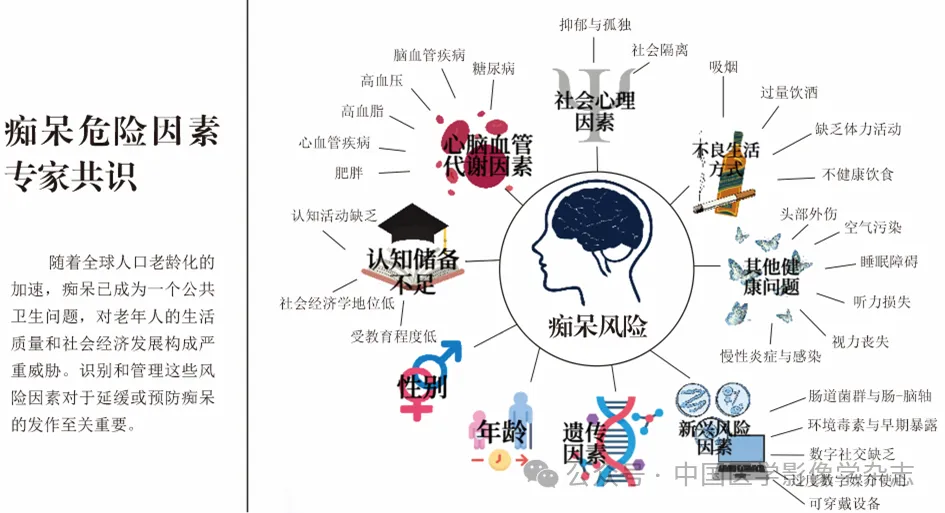
痴呆防控是一项长期而系统的工作,涉及遗传、环境、生活方式及慢性疾病管理等多方面因素(图1)。通过早期识别并干预可调整的危险因素,能够降低痴呆患病风险,延缓疾病进展,改善患者及其家庭的生活质量。

图1  痴呆风险因素概述

神经影像技术在痴呆危险因素评估与早期预警中发挥重要作用。结构MRI可评估海马及内侧颞叶萎缩(MTA评分)、后部皮质萎缩(Koedam评分)等特征性改变,为AD早期诊断提供重要支持证据[136]。PET成像(18F-FDG PET、淀粉样蛋白PET、tau PET)可在症状出现前检测脑内病理性蛋白沉积[137]。未来,结合神经影像、认知测试、生物标志物及可穿戴设备数据的多模态AI预测模型,有望实现痴呆高危人群精准识别和早期干预。

本专家共识强调循证医学证据与本土化实践相结合的重要性,同时呼吁加强多学科协作与公众健康教育。未来,应继续推动开展高质量前瞻性研究,完善危险因素评估与干预体系,尤其加强中国不同地区、城乡和民族人群的长期随访证据积累;同时推动多模态影像、血液标志物、神经心理评估与AI模型的整合应用,提高高危人群分层和干预追踪的精准度。在社区和家庭场景,可探索可穿戴设备对睡眠、体力活动和昼夜节律的连续监测,以提升风险预警的连续性和可及性。

5

专家组名单

指导专家组(按姓氏拼音排序):

陈敏(北京医院),李宏军(首都医科大学附属北京佑安医院),卢洁(首都医科大学宣武医院),刘再毅(广东省人民医院),刘勇(北京邮电大学)

执笔专家组(按姓氏拼音排序):

戴西件(南昌大学第二附属医院),陈国中(南京市第一医院),陈丝雨(南昌大学第二附属医院),陈彦亮(南昌大学第二附属医院),杜磊(西北工业大学),范兵(江西省人民医院),高波(贵州医科大学附属医院),葛歆瞳(天津医科大学总医院),龚亮(四川大学附属成都市第二人民医院),郭崇伦(南昌大学第三附属医院/南昌市第一医院),古训瑚(南昌大学第二附属医院),何宏建(浙江大学),胡建平(福建医科大学附属第一医院),胡晓飞(陆军军医大学第一附属医院/重庆西南医院),黄芬(南昌大学第二附属医院),黄卫(南昌大学第二附属医院),江南(绵阳市中医医院),李宏伟(绵阳市第三人民医院),李三仟(江西财经大学),梁钧贤(澳门大学),卢绍辉(赣南医科大学第一附属医院),刘碧霞(南昌大学第二附属医院),刘少强(赣南医科大学第一附属医院),刘风(天津医科大学总医院),刘绪明(温州市人民医院),刘强(环球医疗烟台海港医院),刘宵雪(南京市第一医院),刘侃(武宁县人民医院),罗艳(南昌大学第二附属医院),骆嵩(蚌埠医科大学第一附属医院),任海波(南昌大学第二附属医院),宋雪刚(广州医科大学),唐春耕(绵阳市第三人民医院),唐震宇(南昌大学第二附属医院),万旻(南昌大学),王丽(齐鲁医药学院),王超(浙江大学医学院附属第二医院),伍忠根(井冈山大学附属医院),吴涛(首都医科大学附属北京天坛医院),王永军(深圳市康宁医院),席春华(合肥市第一人民医院),肖力(中国科学技术大学),胥化虎(绵阳市中医医院),颜建辉(湘南学院附属医院),杨斌(昆明市第一人民医院),曾虹(杭州电子科技大学),张冬玲(首都医科大学附属北京天坛医院),张帆(电子科技大学),张恒敏(华东理工大学),张华(南昌市第一医院),钟俊远(赣州市人民医院),赵峻(绵阳市第三人民医院/四川省精神卫生中心),赵艺蕾(浙江大学医学院附属第一医院),左敏静(南昌大学第二附属医院),周维(浙江大学医学院附属儿童医院),朱晟(湘南学院附属医院)

编写专家组(按姓氏拼音排序,单位均为南昌大学第二附属医院):

陈熙,邓宇,郭马云,贺诗琪,胡梓灏,李诗颖,廖红,刘健婧,刘雪怡,闵婉茹,尚春延,唐鑫辉,王静馨,吴乔博洋,向钊辉,杨晗,余语涵,张涵宾,张铮,章闽洁,周瀚,周慧珺,庄之帆

利益冲突  所有作者声明不存在利益冲突 

参考文献

[1]  Yang K, Yang X, Yin P, et al. Temporal trend and attributable risk factors of Alzheimer’s disease and other dementias burden in China: findings from the Global Burden of Disease Study 2021[J]. Alzheimers Dement, 2024, 20(11): 7871-7884. DOI: 10.1002/alz.14254.

[2]Nichols E, Szoeke CEI, Vollset SE, et al. Global, regional, and national burden of Alzheimer’s disease and other dementias, 1990-2016: a systematic analysis for the global burden of disease study 2016[J]. Lancet Neurol, 2019, 18(1): 88-106. DOI: 10.1016/S1474-4422(18)30403-4.

[3]Hao M, Chen J. Trend analysis and future predictions of global burden of Alzheimer’s disease and other dementias: a study based on the global burden of disease database from 1990 to 2021[J]. BMC Med, 2025, 23(1): 378. DOI: 10.1186/s12916-025-04169-w.

[4]Livingston G, Huntley J, Liu KY, et al. Dementia prevention, intervention, and care: 2024 report of the Lancet standing commission[J]. Lancet, 2024, 404(10452): 572-628. DOI: 10.1016/s0140-6736(24)01296-0.

[5]Zhang B, McEvoy LK, Nguyen S, et al. Epigenetic clocks and longitudinal plasma biomarkers of Alzheimer’s disease[J]. Alzheimers Dement, 2025, 21(12): e70983. DOI: 10.1002/alz. 70983.

[6]Liu Y, Tan Y, Zhang Z, et al. The interaction between ageing and Alzheimer’s disease: insights from the hallmarks of ageing[J]. Transl Neurodegener, 2024, 13(1): 7. DOI: 10.1186/ s40035-024-00397-x.

[7]Jansen WJ, Janssen O, Tijms BM, et al. Prevalence estimates of amyloid abnormality across the Alzheimer disease clinical spectrum[J]. JAMA Neurol, 2022, 79(3): 228-243. DOI: 10.1001/jamaneurol.2021.5216.

[8]Buckley RF, Mormino EC, Rabin JS, et al. Sex differences in the association of global amyloid and regional tau deposition measured by positron emission tomography in clinically normal older adults[J]. JAMA Neurol, 2019, 76(5): 542-551. DOI: 10.1001/jamaneurol.2018.4693.

[9]Coughlan GT, Klinger HM, Boyle R, et al. Sex differences in longitudinal tau-PET in preclinical Alzheimer disease: a meta-analysis[J]. JAMA Neurol, 2025, 82(4): 364-375. DOI: 10.1001/jamaneurol.2025.0013.

[10]Ye Z, Lang H, Xie Z, et al. Associations of combined accelerated biological aging and genetic susceptibility with incident dementia: a prospective study in the UK Biobank[J]. BMC Med, 2024, 22(1): 425. DOI: 10.1186/s12916-024-03640-4.

[11]Licher S, Ahmad S, Karamujić-Čomić H, et al. Genetic predisposition, modifiable-risk-factor profile and long-term dementia risk in the general population[J]. Nat Med, 2019, 25(9): 1364-1369. DOI: 10.1038/s41591-019-0547-7.

[12]Manuello J, Min J, McCarthy P, et al. The effects of genetic and modifiable risk factors on brain regions vulnerable to ageing and disease[J]. Nat Commun, 2024, 15(1): 2576. DOI: 10.1038/ s41467-024-46344-2.

[13]Ward DD, Ranson JM, Wallace LMK, et al. Frailty, lifestyle, genetics and dementia risk[J]. J Neurol Neurosurg Psychiatry, 2022, 93(4): 343-350. DOI: 10.1136/jnnp-2021-327396.

[14]Livingston G, Huntley J, Sommerlad A, et al. Dementia prevention, intervention, and care: 2020 report of the Lancet commission[J]. Lancet, 2020, 396(10248): 413-446. DOI: 10.1016/s0140-6736(20)30367-6.

[15]Chen S, Chen X, Hou X, et al. Temporal trends and disparities of population attributable fractions of modifiable risk factors for dementia in China: a time-series study of the China health and retirement longitudinal study (2011-2018)[J]. Lancet Reg Health West Pac, 2024, 47: 101106. DOI: 10.1016/j.lanwpc.2024. 101106.

[16]Ding D, Zhao Q, Wu W, et al. Prevalence and incidence of dementia in an older Chinese population over two decades: the role of education[J]. Alzheimers Dement, 2020, 16(12): 1650-1662. DOI: 10.1002/alz.12159.

[17]Hayward MD, Farina MP, Zhang YS, et al. The importance of improving educational attainment for dementia prevalence trends from 2000 to 2014, among older non-hispanic black and white Americans[J]. J Gerontol Ser B, 2021, 76(9): 1870-1879. DOI: 10.1093/geronb/gbab015.

[18]Ren L, Liang J, Wan F, et al. Development of a clinical risk score prediction tool for 5-, 9-, and 13-year risk of dementia[J]. JAMA Netw Open, 2022, 5(11): e2242596. DOI: 10.1001/jamanetworkopen.2022.42596.

[19] Xu W, Tan L, Wang H, et al. Education and risk of dementia: dose-response meta-analysis of prospective cohort studies[J]. Mol Neurobiol, 2016, 53(5): 3113-3123. DOI: 10.1007/s12035-015-9211-5.

[20]Seblova D, Fischer M, Fors S, et al. Does prolonged education causally affect dementia risk when adult socioeconomic status is not altered? A Swedish natural experiment in 1.3 million individuals[J]. Am J Epidemiol, 2021, 190(5): 817-826. DOI: 10.1093/aje/kwaa255.

[21]Walsh S, Klee M, Hui EK, et al. Social determinants of dementia: a scoping review[J]. Alzheimers Dement, 2025, 21(7): e70524. DOI: 10.1002/alz.70524.

[22]Zhang Y, Chen S, Deng Y, et al. Identifying modifiable factors and their joint effect on dementia risk in the UK Biobank[J]. Nat Hum Behav, 2023, 7(7): 1185-1195. DOI: 10.1038/s41562-023-01585-x.

[23]Li R, Li R, Xie J, et al. Associations of socioeconomic status and healthy lifestyle with incident early-onset and late-onset dementia: a prospective cohort study[J]. Lancet Healthy Longev, 2023, 4(12): e693-e702. DOI: 10.1016/s2666-7568(23)00211-8.

[24]Mollalo A, Kramer M, Cutty M, et al. Systematic review and meta-analysis of rural-urban disparities in Alzheimer’s disease dementia prevalence[J]. J Prev Alzheimers Dis, 2025, 12(9): 100305. DOI: 10.1016/j.tjpad.2025.100305.

[25]Trani JF, Singh RK, Walker AIB, et al. Structural and social determinants of dementia risk among adults racialized as Black: results from a community-based system dynamics approach[J]. Alzheimers Dement, 2025, 21(7): e70494. DOI: 10.1002/alz. 70494.

[26]Lecca D, Jung YJ, Scerba MT, et al. Role of chronic neuroinflammation in neuroplasticity and cognitive function: a hypothesis[J]. Alzheimers Dement, 2022, 18(11): 2327-2340. DOI: 10.1002/alz.12610.

[27]Shetty PK, Galeffi F, Turner DA. Cellular links between neuronal activity and energy homeostasis[J]. Front Pharmacol, 2012, 3: 43. DOI: 10.3389/fphar.2012.00043.

[28]Aidil-Carvalho MF, Carmo AJS, Ribeiro JA, et al. Mismatch novelty exploration training enhances hippocampal synaptic plasticity: a tool for cognitive stimulation?[J]. Neurobiol Learn Mem, 2017, 145: 240-250. DOI: 10.1016/j.nlm.2017.09.004.

[29]Kivimäki M, Walker KA, Pentti J, et al. Cognitive stimulation in the workplace, plasma proteins, and risk of dementia: three analyses of population cohort studies[J]. BMJ, 2021, 374: n1804. DOI: 10.1136/bmj.n1804.

[30]Gómez-Soria I, Iguacel I, Aguilar-Latorre A, et al. Cognitive stimulation and cognitive results in older adults: a systematic review and meta-analysis[J]. Arch Gerontol Geriatr, 2023, 104: 104807. DOI: 10.1016/j.archger.2022.104807.

[31]Gottesman RF, Egle M, Groechel RC, et al. Blood pressure and the brain: the conundrum of hypertension and dementia[J]. Cardiovasc Res, 2025, 120(18): 2360-2372. DOI: 10.1093/cvr/ cvaf010.

[32]Hainsworth AH, Markus HS, Schneider JA. Cerebral small vessel disease, hypertension, and vascular contributions to cognitive impairment and dementia[J]. Hypertension, 2024, 81(1): 75-86. DOI: 10.1161/hypertensionaha.123.19943.

[33]Santisteban MM, Iadecola C, Carnevale D. Hypertension, neurovascular dysfunction, and cognitive impairment[J]. Hypertension, 2023, 80(1): 22-34. DOI: 10.1161/hypertensionaha. 122.18085.

[34]Carnevale L, Maffei A, Landolfi A, et al. Brain functional magnetic resonance imaging highlights altered connections and functional networks in patients with hypertension[J]. Hypertension, 2020, 76(5): 1480-1490. DOI: 10.1161/ hypertensionaha.120.15296.

[35]He J, Zhao C, Zhong S, et al. Blood pressure reduction and all-cause dementia in people with uncontrolled hypertension: an open-label, blinded-endpoint, cluster-randomized trial[J]. Nat Med, 2025, 31(6): 2054-2061. DOI: 10.1038/s41591-025-03616-8.

[36]Cheng G, He S, He Q, et al. Trajectory patterns of blood pressure change up to six years and the risk of dementia: a nationwide cohort study[J]. Aging, 2021, 13(13): 17380-17406. DOI: 10.18632/aging.203228.

[37]Walker KA, Sharrett AR, Wu A, et al. Association of midlife to late-life blood pressure patterns with incident dementia[J]. Jama, 2019, 322(6): 535-545. DOI: 10.1001/jama.2019.10575.

[38]Lyon M, Fullerton JL, Kennedy S, et al. Hypertension & dementia: pathophysiology & potential utility of antihypertensives in reducing disease burden[J]. Pharmacol Ther, 2024, 253: 108575. DOI: 10.1016/j.pharmthera.2023.108575.

[39]梁喆, 范芳芳, 张岩, 等. 中国高血压人群中H型高血压的比率和特征及与美国人群的比较[J]. 北京大学学报(医学版), 2022, 54(5): 1028-1037. DOI: 10.19723/j.issn.1671-167x.2022.05.033.

[40]Kale MB, Bhondge HM, Wankhede NL, et al. Navigating the intersection: diabetes and Alzheimer’s intertwined relationship[J]. Ageing Res Rev, 2024, 100: 102415. DOI: 10.1016/j.arr. 2024.102415.

[41]Pramanik R, Dey A, Chakrabarty AK, et al. Diabetes mellitus and Alzheimer’s disease: understanding disease mechanisms, their correlation, and promising dual activity of selected herbs[J]. J Ethnopharmacol, 2024, 333: 118402. DOI: 10.1016/j.jep. 2024.118402.

[42]Dove A, Wang J, Huang H, et al. Diabetes, prediabetes, and brain aging: the role of healthy lifestyle[J]. Diabetes Care, 2024, 47(10): 1794-1802. DOI: 10.2337/dc24-0860.

[43]Zhang H, Long X, Niu G, et al. Genetic insights into lipid traits and atherosclerosis risk: a Mendelian randomization and polygenic risk score analysis[J]. Int J Surg, 2025, 111(10): 6802-6815. DOI: 10.1097/js9.0000000000002869.

[44]Kaye S, Gold A, Lin D, et al. Hypercholesterolemia drives microglial dysfunction and weakens response to amyloid plaques[J]. Exp Neurol, 2025, 390: 115272. DOI: 10.1016/ j.expneurol.2025.115272.

[45]Kang SH, Yoo H, Cheon BK, et al. Distinct effects of cholesterol profile components on amyloid and vascular burdens[J]. Alzheimers Res Ther, 2023, 15(1): 197. DOI: 10.1186/s13195-023-01342-2.

[46]Jia L, Du Y, Chu L, et al. Prevalence, risk factors, and management of dementia and mild cognitive impairment in adults aged 60 years or older in China: a cross-sectional study[J]. Lancet Public Health, 2020, 5(12): e661-e671. DOI: 10.1016/ s2468-2667(20)30185-7.

[47]Iwagami M, Qizilbash N, Gregson J, et al. Blood cholesterol and risk of dementia in more than 1·8 million people over two decades: a retrospective cohort study[J]. Lancet Healthy Longev, 2021, 2(8): e498-e506. DOI: 10.1016/s2666-7568(21)00150-1.

[48]Zhai W, Zhao M, Wei C, et al. Obesity-induced chronic low-grade inflammation in adipose tissue: a pathway to Alzheimer’s disease[J]. Ageing Res Rev, 2024, 99: 102402. DOI: 10.1016/j.arr.2024.102402.

[49]Fang S, Guan L, Jian H, et al. Body weight and BMI variability linked to dementia risk: a meta-analysis[J]. Biomol Biomed, 2025, 25(12): 2632-2646. DOI: 10.17305/bb.2025.12626.

[50]Charisis S, Lin H, Ray R, et al. Obesity impacts the expression of Alzheimer’s disease-related genes: the Framingham Heart Study[J]. Alzheimers Dement, 2023, 19(8): 3496-3505. DOI: 10.1002/alz.12954.

[51]Saeed A, Lopez O, Cohen A, et al. Cardiovascular disease and Alzheimer’s disease: the heart-brain axis[J]. J Am Heart Assoc, 2023, 12(21): e030780. DOI: 10.1161/jaha.123.030780.

[52]Cortes-Canteli M, Iadecola C. Alzheimer’s disease and vascular aging: JACC focus seminar[J]. J Am Coll Cardiol, 2020, 75(8): 942-951. DOI: 10.1016/j.jacc.2019.10.062.

[53]Iadecola C, Duering M, Hachinski V, et al. Vascular cognitive impairment and dementia: JACC scientific expert panel[J]. J Am Coll Cardiol, 2019, 73(25): 3326-3344. DOI: 10.1016/j.jacc. 2019.04.034.

[54]Ou Y, Kuo K, Yang L, et al. Longitudinal associations of cardiovascular health and vascular events with incident dementia[J]. Stroke Vasc Neurol, 2024, 9(4): 418-428. DOI: 10.1136/svn-2023-002665.

[55]Szu JI, Obenaus A. Cerebrovascular phenotypes in mouse models of Alzheimer's disease[J]. J Cereb Blood Flow Metab, 2021, 41(8): 1821-1841. DOI: 10.1177/0271678X21992462.

[56]Greenberg SM, Bacskai BJ, Hernandez-Guillamon M, et al. Cerebral amyloid angiopathy and Alzheimer disease: one peptide, two pathways[J]. Nat Rev Neurol, 2020, 16(1): 30-42. DOI: 10.1038/s41582-019-0281-2.

[57]Arvanitakis Z, Capuano AW, Leurgans SE, et al. Relation of cerebral vessel disease to Alzheimer’s disease dementia and cognitive function in elderly people: a cross-sectional study[J]. Lancet Neurol, 2016, 15(9): 934-943. DOI: 10.1016/s1474-4422(16)30029-1.

[58]Sabayan B, Goudarzi R, Ji Y, et al. Intracranial atherosclerosis disease associated with cognitive impairment and dementia: systematic review and meta-analysis[J]. J Am Heart Assoc, 2023, 12(22): e032506. DOI: 10.1161/jaha.123.032506.

[59]Rabin JS, Nichols E, La Joie R, et al. Cerebral amyloid angiopathy interacts with neuritic amyloid plaques to promote tau and cognitive decline[J]. Brain, 2022, 145(8): 2823-2833. DOI: 10.1093/brain/awac178.

[60]Ewees MG, El-Mahdy MA, Hannawi Y, et al. Tobacco cigarette smoking induces cerebrovascular dysfunction followed by oxidative neuronal injury with the onset of cognitive impairment[J]. J Cereb Blood Flow Metab, 2025, 45(1): 48-65. DOI: 10.1177/0271678x241270415.

[61]Johnson AL, Nystrom NC, Piper ME, et al. Cigarette smoking status, cigarette exposure, and duration of abstinence predicting incident dementia and death: a multistate model approach[J]. J Alzheimers Dis, 2021, 80(3): 1013-1023. DOI: 10.3233/JAD-201332.

[62]Topiwala A, Allan CL, Valkanova V, et al. Moderate alcohol consumption as risk factor for adverse brain outcomes and cognitive decline: longitudinal cohort study[J]. BMJ, 2017, 357: j2353. DOI: 10.1136/bmj.j2353.

[63]Rao PSS, Bell RL, Engleman EA, et al. Targeting glutamate uptake to treat alcohol use disorders[J]. Front Neurosci, 2015, 9: 144. DOI: 10.3389/fnins.2015.00144.

[64]Eva L, Brehar FM, Florian IA, et al. Neuropsychiatric and neuropsychological aspects of alcohol-related cognitive disorders: an in-depth review of Wernicke’s encephalopathy and korsakoff’s syndrome[J]. J Clin Med, 2023, 12(18): 6101. DOI: 10.3390/jcm12186101.

[65]Morgan AE, Mc Auley MT. Vascular dementia: from pathobiology to emerging perspectives[J]. Ageing Res Rev, 2024, 96: 102278. DOI: 10.1016/j.arr.2024.102278.

[66]Kilian C, Klinger S, Rehm J, et al. Alcohol use, dementia risk, and sex: a systematic review and assessment of alcohol-attributable dementia cases in Europe[J]. BMC Geriatr, 2023, 23(1): 246. DOI: 10.1186/s12877-023-03972-5.

[67]Tari AR, Walker TL, Huuha AM, et al. Neuroprotective mechanisms of exercise and the importance of fitness for healthy brain ageing[J]. Lancet, 2025, 405(10484): 1093-1118. DOI: 10.1016/s0140-6736(25)00184-9.

[68]Qureshi D, Collister J, Allen NE, et al. Association between metabolic syndrome and risk of incident dementia in UK Biobank[J]. Alzheimers Dement, 2024, 20(1): 447-458. DOI: 10.1002/alz.13439.

[69]Schaefer SM, Kaiser A, Eichner G, et al. Association of sugar intake from different sources with incident dementia in the prospective cohort of UK Biobank participants[J]. Nutr J, 2023, 22(1): 42. DOI: 10.1186/s12937-023-00871-8.

[70]Barnard ND, Bunner AE, Agarwal U. Saturated and trans fats and dementia: a systematic review[J]. Neurobiol Aging, 2014, 35(Suppl 2): S65-S73. DOI: 10.1016/j.neurobiolaging.2014. 02.030.

[71]Henney AE, Gillespie CS, Alam U, et al. High intake of ultra-processed food is associated with dementia in adults: a systematic review and meta-analysis of observational studies[J]. J Neurol, 2024, 271(1): 198-210. DOI: 10.1007/s00415-023-12033-1.

[72]Bian D, Liang F, You Y, et al. Evaluating dietary quality and dietary inflammatory potential in cognitive impairment patients in China[J]. Alzheimers Dement, 2025, 21(6): e70345. DOI: 10.1002/alz.70345.

[73]Liu C, Meng Q, Zu C, et al. Dietary low- and high-quality carbohydrate intake and cognitive decline: a prospective cohort study in older adults[J]. Clin Nutr, 2023, 42(8): 1322-1329. DOI: 10.1016/j.clnu.2023.06.021.

[74]Charisis S, Yannakoulia M, Scarmeas N. Diets to promote healthy brain ageing[J]. Nat Rev Neurol, 2025, 21(1): 5-16. DOI: 10.1038/s41582-024-01036-9.

[75]Sutin AR, Stephan Y, Luchetti M, et al. Loneliness and risk of dementia[J]. J Gerontol B Psychol Sci Soc Sci, 2020, 75(7): 1414-1422. DOI: 10.1093/geronb/gby112.

[76]Shen C, Rolls ET, Cheng W, et al. Associations of social isolation and loneliness with later dementia[J]. Neurology, 2022, 99(2): e164-e175. DOI: 10.1212/wnl.0000000000200583.

[77]Elser H, Horváth-Puhó E, Gradus JL, et al. Association of early-, middle-, and late-life depression with incident dementia in a Danish cohort[J]. JAMA Neurol, 2023, 80(9): 949-958. DOI: 10.1001/jamaneurol.2023.2309.

[78]Kontari P, Fife-Schaw C, Smith K. Independent and combined effects of depressive symptoms and cardiometabolic risk factors on dementia incidence: a cross-country comparison in England, the United States and China[J]. Arch Gerontol Geriatr, 2025, 136: 105889. DOI: 10.1016/j.archger.2025.105889.

[79]Tao Q, Akhter-Khan SC, Ang TFA, et al. Different loneliness types, cognitive function, and brain structure in midlife: findings from the Framingham Heart Study[J]. EClinicalMedicine, 2022, 53: 101643. DOI: 10.1016/j.eclinm.2022.101643.

[80]Xiao X, Li Y, Wu Q, et al. Development and validation of a novel predictive model for dementia risk in middle-aged and elderly depression individuals: a large and longitudinal machine learning cohort study[J]. Alzheimers Res Ther, 2025, 17(1): 103. DOI: 10.1186/s13195-025-01750-6.

[81]Huang Q, Zhang P, Shen D, et al. Analysis of changes in social isolation, loneliness, or both, and subsequent cognitive function among older adults: findings from a nationwide cohort study[J]. Alzheimers Dement, 2024, 20(8): 5674-5683. DOI: 10.1002/alz. 14080.

[82]Shafighi K, Villeneuve S, Rosa Neto P, et al. Social isolation is linked to classical risk factors of Alzheimer’s disease-related dementias[J]. PLoS One, 2023, 18(2): e0280471. DOI: 10.1371/ journal.pone.0280471.

[83]Sakimoto F, Doi T, Tomida K, et al. Cognitive activity levels associated with dementia risk in older adults with social frailty: a longitudinal study[J]. Maturitas, 2025, 198: 108597. DOI: 10.1016/j.maturitas.2025.108597.

[84]Wu M, Rosenberg P, Spira A, et al. Sleep disturbance, cognitive decline, and dementia: a review[J]. Semin Neurol, 2017, 37(4): 395-406. DOI: 10.1055/s-0037-1604351.

[85]de Souza ÂMN, de Souza Fernandes DP, Castro IS, et al. Sleep quality and duration and frailty in older adults: a systematic review[J]. Front Public Health, 2025, 13: 1539849. DOI: 10.3389/fpubh.2025.1539849.

[86]Wang C, Holtzman DM. Bidirectional relationship between sleep and Alzheimer’s disease: role of amyloid, tau, and other factors[J]. Neuropsychopharmacology, 2020, 45(1): 104-120. DOI: 10.1038/s41386-019-0478-5.

[87]Ju YS, Lucey BP, Holtzman DM. Sleep and Alzheimer disease pathology: a bidirectional relationship[J]. Nat Rev Neurol, 2014, 10(2): 115-119. DOI: 10.1038/nrneurol.2013.269.

[88]Lucey BP, McCullough A, Landsness EC, et al. Reduced non-rapid eye movement sleep is associated with tau pathology in early Alzheimer’s disease[J]. Sci Transl Med, 2019, 11(474): eaau6550. DOI: 10.1126/scitranslmed.aau6550.

[89]Irwin MR, Vitiello MV. Implications of sleep disturbance and inflammation for Alzheimer’s disease dementia[J]. Lancet Neurol, 2019, 18(3): 296-306. DOI: 10.1016/S1474-4422(18) 30450-2.

[90]Dejanovic B, Wu T, Tsai MC, et al. Complement C1q-dependent excitatory and inhibitory synapse elimination by astrocytes and microglia in Alzheimer’s disease mouse models[J]. Nat Aging, 2022, 2(9): 837-850. DOI: 10.1038/ s43587-022-00281-1.

[91]Xu W, Huang Y, Zhou R. NLRP3 inflammasome in neuroinflammation and central nervous system diseases[J]. Cell Mol Immunol, 2025, 22(4): 341-355. DOI: 10.1038/s41423-025-01275-w.

[92]Chen Y, Yu Y. Tau and neuroinflammation in Alzheimer’s disease: interplay mechanisms and clinical translation[J]. J Neuroinflammation, 2023, 20(1): 165. DOI: 10.1186/s12974-023-02853-3.

[93]Chen X, Firulyova M, Manis M, et al. Microglia-mediated T cell infiltration drives neurodegeneration in tauopathy[J]. Nature, 2023, 615(7953): 668-677. DOI: 10.1038/s41586-023-05788-0.

[94]Kusters MSW, Granés L, Petricola S, et al. Exposure to residential air pollution and the development of functional connectivity of brain networks throughout adolescence[J]. Environ Int, 2025, 196: 109245. DOI: 10.1016/j.envint.2024. 109245.

[95]Schneider ALC, Law CA, Gottesman RF, et al. Posttraumatic epilepsy and dementia risk[J]. JAMA Neurol, 2024, 81(4): 346-353. DOI: 10.1001/jamaneurol.2024.0010.

[96]Sweeney N, Kim TY, Morrison CT, et al. Neuronal BAG3 attenuates tau hyperphosphorylation, synaptic dysfunction, and cognitive deficits induced by traumatic brain injury via the regulation of autophagy-lysosome pathway[J]. Acta Neuropathol, 2024, 148(1): 52. DOI: 10.1007/s00401-024-02810-1.

[97]Graham NSN, Zimmerman KA, Hain J, et al. Biomarker evidence of neurodegeneration in mid-life former rugby players[J]. Brain, 2025, 148(8): 2684-2697. DOI: 10.1093/brain/ awaf152.

[98]Peelle JE, Wingfield A. The neural consequences of age-related hearing loss[J]. Trends Neurosci, 2016, 39(7): 486-497. DOI: 10.1016/j.tins.2016.05.001.

[99]Maharani A, Dawes P, Nazroo J, et al. Longitudinal relationship between hearing aid use and cognitive function in older Americans[J]. J Am Geriatr Soc, 2018, 66(6): 1130-1136. DOI: 10.1111/jgs.15363.

[100]Chen SP, Bhattacharya J, Pershing S. Association of vision loss with cognition in older adults[J]. JAMA Ophthalmol, 2017, 135(9): 963-970. DOI: 10.1001/jamaophthalmol.2017.2838.

[101]Varadaraj V, Munoz B, Deal JA, et al. Association of vision impairment with cognitive decline across multiple domains in older adults[J]. JAMA Netw Open, 2021, 4(7): e2117416. DOI: 10.1001/jamanetworkopen.2021.17416.

[102]Kim J, Han K, Jung JH, et al. Optic neuritis as a link between autoimmunity and dementia risk[J]. Commun Med, 2025, 5(1): 335. DOI: 10.1038/s43856-025-01050-y.

[103]Lee CS, Gibbons LE, Lee AY, et al. Association between cataract extraction and development of dementia[J]. JAMA Intern Med, 2022, 182(2): 134-141. DOI: 10.1001/jamainternmed. 2021.6990.

[104]Cryan JF, O’Riordan KJ, Cowan CSM, et al. The microbiota-gut-brain axis[J]. Physiol Rev, 2019, 99(4): 1877-2013. DOI: 10.1152/physrev.00018.2018.

[105]Lei W, Cheng Y, Liu X, et al. Gut microbiota-driven neuroinflammation in Alzheimer’s disease: from mechanisms to therapeutic opportunities[J]. Front Immunol, 2025, 16: 1582119. DOI: 10.3389/fimmu.2025.1582119.

[106]Vogt NM, Romano KA, Darst BF, et al. The gut microbiota-derived metabolite trimethylamine N-oxide is elevated in Alzheimer’s disease[J]. Alzheimers Res Ther, 2018, 10(1): 124. DOI: 10.1186/s13195-018-0451-2.

[107]Liang X, Fu Y, Cao W, et al. Gut microbiome, cognitive function and brain structure: a multi-omics integration analysis[J]. Transl Neurodegener, 2022, 11(1): 49. DOI: 10.1186/s40035-022-00323-z.

[108]Yang J, Liang J, Hu N, et al. The gut microbiota modulates neuroinflammation in Alzheimer’s disease: elucidating crucial factors and mechanistic underpinnings[J]. CNS Neurosci Ther, 2024, 30(10): e70091. DOI: 10.1111/cns.70091.

[109]Lista S, Munafò A, Caraci F, et al. Gut microbiota in Alzheimer’s disease: understanding molecular pathways and potential therapeutic perspectives[J]. Ageing Res Rev, 2025, 104: 102659. DOI: 10.1016/j.arr.2025.102659.

[110]Dorsey ER, De Miranda BR, Hussain S, et al. Environmental toxicants and Parkinson’s disease: recent evidence, risks, and prevention opportunities[J]. Lancet Neurol, 2025, 24(11): 976-986. DOI: 10.1016/s1474-4422(25)00287-x.

[111]Yang Y, Yang W, Cao W, et al. Association of toxic metal exposure with cognitive function in elderly Chinese: potential modification by difficulties falling asleep[J]. Biol Trace Elem Res, 2026, 204(3): 1343-1355. DOI: 10.1007/s12011-025-04752-5.

[112]Wu F, Kartiosuo N, Kaikkonen J, et al. Childhood exposure to multiple persistent organic pollutants and midlife cognitive function[J]. Sci Total Environ, 2026, 1020: 181552. DOI: 10.1016/j.scitotenv.2026.181552.

[113]Xu Z, Fang J, Yang C, et al. Prenatal exposure to organochlorine pesticides and early childhood neurodevelopment: a prospective birth cohort study[J]. Ecotoxicol Environ Saf, 2026, 312: 119927. DOI: 10.1016/j.ecoenv.2026.119927.

[114]Qi J, Zhao N, Liu M, et al. Long-term exposure to fine particulate matter constituents and cognitive impairment among older adults: an 18-year Chinese nationwide cohort study[J]. J Hazard Mater, 2024, 468: 133785. DOI: 10.1016/j.jhazmat.2024.133785.

[115]Cheng Y, Zhao Y, Chen C, et al. Heavy metals toxicity: mechanism, health effects, and therapeutic interventions[J]. MedComm, 2025, 6(9): e70241. DOI: 10.1002/mco2.70241.

[116]Gauvrit T, Benderradji H, Buée L, et al. Early-life environment influence on late-onset Alzheimer’s disease[J]. Front Cell Dev Biol, 2022, 10: 834661. DOI: 10.3389/fcell.2022.834661.

[117]Horoszkiewicz B. Digital dementia and its impact on human cognitive and emotional functioning[J]. J Educ Health Sport, 2022, 12(11): 290-296. DOI: 10.12775/jehs.2022.12.11.038.

[118]Joshi P, Hendrie K, Jester DJ, et al. Social connections as determinants of cognitive health and as targets for social interventions in persons with or at risk of Alzheimer’s disease and related disorders: a scoping review[J]. Int Psychogeriatr, 2024, 36(2): 92-118. DOI: 10.1017/s1041610223000923.

[119]Li S, Yin Y, Yunus MM. Elderly people in the digital cultural environment: social media use, environmental stress, and intergenerational interaction[J]. Environ Behav Proc J, 2025, 10(31): 433-439. DOI: 10.21834/e-bpj.v10i31.6643.

[120]Lu Q, Rong B, Meng X, et al. WeChat adoption among older adults and urban-rural differences in China[J]. Int J Hum, 2025, 41(9): 5591-5606. DOI: 10.1080/10447318.2024.2364475.

[121]Lu X, Yao Y, Jin Y. Digital exclusion and functional dependence in older people: findings from five longitudinal cohort studies[J]. eClinicalMedicine, 2022, 54: 101708. DOI: 10.1016/j.eclinm. 2022.101708.

[122]Liu X, Wang X, Zhang H, et al. Relationship between digital exclusion and cognitive impairment in Chinese adults[J]. Front Aging Neurosci, 2023, 15: 1194348. DOI: 10.3389/fnagi.2023. 1194348.

[123]Choi S, Ko H. Social frailty among community-dwelling older adults during the COVID-19 pandemic in Korea: a cross-sectional study[J]. Int J Environ Res Public Health, 2022, 19(19): 11963. DOI: 10.3390/ijerph191911963.

[124]Lu J, Ruan Y. Exploring the reciprocal relationship between depressive symptoms and cognitive function among Chinese older adults[J]. Healthcare, 2023, 11(21): 2880. DOI: 10.3390/ healthcare11212880.

[125]Szymanowicz O. Molecular basis of dementia[J]. J Multisc Neurosci, 2024, 3(1): 53-63. DOI: 10.56280/1605703412.

[126]Liang C, Subramaniam P, Goh NSMR, et al. Digital device use, risk of cognitive impairment, and cognition in healthy older adults: the role of cognitive reserve[J]. Healthcare, 2023, 11(21): 2822. DOI: 10.3390/healthcare11212822.

[127]Guan DX, Mortby ME, Pike GB, et al. Linking cognitive and behavioral reserve: evidence from the CAN-PROTECT study[J]. Alzheimers Dement, 2024, 10(4): e12497. DOI: 10.1002/trc2.12497.

[128]Amos JG, Zheng L, Eramudugolla R, et al. A scoping survey to inform design of digital dementia risk reduction interventions for adults concerned about their cognitive health[J]. J Alzheimers Dis Rep, 2024, 8(1): 697-708. DOI: 10.3233/adr-230160.

[129]Chen Q, Ji H, Shang Q. The association between the diversity of online activities on smartphones and cognitive function among middle-aged and elderly Chinese adults[J]. BMC Public Health, 2024, 24(1): 547. DOI: 10.1186/s12889-024-17932-0.

[130]Lee S, Harada K, Bae S, et al. A non-pharmacological multidomain intervention of dual-task exercise and social activity affects the cognitive function in community-dwelling older adults with mild to moderate cognitive decline: a randomized controlled trial[J]. Front Aging Neurosci, 2023, 15: 1005410. DOI: 10.3389/fnagi.2023.1005410.

[131]Feter N, Feter JS, Borelli WV, et al. Potentially modifiable risk factors for dementia in six low-income and middle-income countries: a multinational, population-based survey[J]. Maturitas, 2024, 183: 107968. DOI: 10.1016/j.maturitas.2024. 107968.

[132]Cejudo A, Arrojo M, Martín C, et al. AI and wearables for early detection of cognitive impairment and dementia: systematic review[J]. J Med Internet Res, 2026, 28: e86262. DOI: 10.2196/86262.

[133]Chan LLY, Espinoza Cerda MT, Brodie MA, et al. Daily-life walking speed, running duration and bedtime from wrist-worn sensors predict incident dementia: a watch walk-UK biobank study[J]. Int Psychogeriatr, 2025, 37(3): 100031. DOI: 10.1016/ j.inpsyc.2024.100031.

[134]Karam Y, Shum LC, Faruk T, et al. Digital markers and phenotypes of rest-activity rhythms in people with advanced dementia using real-time location data[J]. J Gerontol A Biol Sci Med Sci, 2026, 81(3): glaf288. DOI: 10.1093/gerona/glaf288.

[135]Gramkow MH, Gleerup HSC, Simonsen AH, et al. Digital biomarkers in early Alzheimer’s disease from wearable or portable technology: a scoping review[J]. J Neurol Sci, 2026, 481: 125734. DOI: 10.1016/j.jns.2026.125734.

[136]中华医学会放射学分会磁共振学组北京认知神经科学学会. 阿尔茨海默病MR检查规范中国专家共识[J]. 中华放射学杂志, 2019, 53(8): 665-671. DOI: 10.3760/cma.j.issn.1005-1201. 2019.08.002.

[137]Jack CR, Andrews SJ, Beach TG, et al. Revised criteria for the diagnosis and staging of Alzheimer’s disease[J]. Nat Med, 2024, 30(8): 2121-2124. DOI: 10.1038/s41591-024-02988-7.


向下滑动查看更多参考文献

版权声明

本文为《中国医学影像学杂志》原创文章。若您需要转载本文,请通过公众号联系本刊编辑部获得授权,并在醒目位置注明“原文刊发于《中国医学影像学杂志》,卷(期):起止页码”,期待与您的合作!

最新文章

随机文章

基本 文件 流程 错误 SQL 调试
  1. 请求信息 : 2026-05-12 14:42:33 HTTP/2.0 GET : https://a.460.net.cn/a/503616.html
  2. 运行时间 : 0.112551s [ 吞吐率:8.88req/s ] 内存消耗:4,950.41kb 文件加载:140
  3. 缓存信息 : 0 reads,0 writes
  4. 会话信息 : SESSION_ID=11b410565e1b8d51a0f94ee39f380788
  1. /yingpanguazai/ssd/ssd1/www/a.460.net.cn/public/index.php ( 0.79 KB )
  2. /yingpanguazai/ssd/ssd1/www/a.460.net.cn/vendor/autoload.php ( 0.17 KB )
  3. /yingpanguazai/ssd/ssd1/www/a.460.net.cn/vendor/composer/autoload_real.php ( 2.49 KB )
  4. /yingpanguazai/ssd/ssd1/www/a.460.net.cn/vendor/composer/platform_check.php ( 0.90 KB )
  5. /yingpanguazai/ssd/ssd1/www/a.460.net.cn/vendor/composer/ClassLoader.php ( 14.03 KB )
  6. /yingpanguazai/ssd/ssd1/www/a.460.net.cn/vendor/composer/autoload_static.php ( 4.90 KB )
  7. /yingpanguazai/ssd/ssd1/www/a.460.net.cn/vendor/topthink/think-helper/src/helper.php ( 8.34 KB )
  8. /yingpanguazai/ssd/ssd1/www/a.460.net.cn/vendor/topthink/think-validate/src/helper.php ( 2.19 KB )
  9. /yingpanguazai/ssd/ssd1/www/a.460.net.cn/vendor/topthink/think-orm/src/helper.php ( 1.47 KB )
  10. /yingpanguazai/ssd/ssd1/www/a.460.net.cn/vendor/topthink/think-orm/stubs/load_stubs.php ( 0.16 KB )
  11. /yingpanguazai/ssd/ssd1/www/a.460.net.cn/vendor/topthink/framework/src/think/Exception.php ( 1.69 KB )
  12. /yingpanguazai/ssd/ssd1/www/a.460.net.cn/vendor/topthink/think-container/src/Facade.php ( 2.71 KB )
  13. /yingpanguazai/ssd/ssd1/www/a.460.net.cn/vendor/symfony/deprecation-contracts/function.php ( 0.99 KB )
  14. /yingpanguazai/ssd/ssd1/www/a.460.net.cn/vendor/symfony/polyfill-mbstring/bootstrap.php ( 8.26 KB )
  15. /yingpanguazai/ssd/ssd1/www/a.460.net.cn/vendor/symfony/polyfill-mbstring/bootstrap80.php ( 9.78 KB )
  16. /yingpanguazai/ssd/ssd1/www/a.460.net.cn/vendor/symfony/var-dumper/Resources/functions/dump.php ( 1.49 KB )
  17. /yingpanguazai/ssd/ssd1/www/a.460.net.cn/vendor/topthink/think-dumper/src/helper.php ( 0.18 KB )
  18. /yingpanguazai/ssd/ssd1/www/a.460.net.cn/vendor/symfony/var-dumper/VarDumper.php ( 4.30 KB )
  19. /yingpanguazai/ssd/ssd1/www/a.460.net.cn/vendor/topthink/framework/src/think/App.php ( 15.30 KB )
  20. /yingpanguazai/ssd/ssd1/www/a.460.net.cn/vendor/topthink/think-container/src/Container.php ( 15.76 KB )
  21. /yingpanguazai/ssd/ssd1/www/a.460.net.cn/vendor/psr/container/src/ContainerInterface.php ( 1.02 KB )
  22. /yingpanguazai/ssd/ssd1/www/a.460.net.cn/app/provider.php ( 0.19 KB )
  23. /yingpanguazai/ssd/ssd1/www/a.460.net.cn/vendor/topthink/framework/src/think/Http.php ( 6.04 KB )
  24. /yingpanguazai/ssd/ssd1/www/a.460.net.cn/vendor/topthink/think-helper/src/helper/Str.php ( 7.29 KB )
  25. /yingpanguazai/ssd/ssd1/www/a.460.net.cn/vendor/topthink/framework/src/think/Env.php ( 4.68 KB )
  26. /yingpanguazai/ssd/ssd1/www/a.460.net.cn/app/common.php ( 0.03 KB )
  27. /yingpanguazai/ssd/ssd1/www/a.460.net.cn/vendor/topthink/framework/src/helper.php ( 18.78 KB )
  28. /yingpanguazai/ssd/ssd1/www/a.460.net.cn/vendor/topthink/framework/src/think/Config.php ( 5.54 KB )
  29. /yingpanguazai/ssd/ssd1/www/a.460.net.cn/config/app.php ( 0.95 KB )
  30. /yingpanguazai/ssd/ssd1/www/a.460.net.cn/config/cache.php ( 0.78 KB )
  31. /yingpanguazai/ssd/ssd1/www/a.460.net.cn/config/console.php ( 0.23 KB )
  32. /yingpanguazai/ssd/ssd1/www/a.460.net.cn/config/cookie.php ( 0.56 KB )
  33. /yingpanguazai/ssd/ssd1/www/a.460.net.cn/config/database.php ( 2.48 KB )
  34. /yingpanguazai/ssd/ssd1/www/a.460.net.cn/vendor/topthink/framework/src/think/facade/Env.php ( 1.67 KB )
  35. /yingpanguazai/ssd/ssd1/www/a.460.net.cn/config/filesystem.php ( 0.61 KB )
  36. /yingpanguazai/ssd/ssd1/www/a.460.net.cn/config/lang.php ( 0.91 KB )
  37. /yingpanguazai/ssd/ssd1/www/a.460.net.cn/config/log.php ( 1.35 KB )
  38. /yingpanguazai/ssd/ssd1/www/a.460.net.cn/config/middleware.php ( 0.19 KB )
  39. /yingpanguazai/ssd/ssd1/www/a.460.net.cn/config/route.php ( 1.89 KB )
  40. /yingpanguazai/ssd/ssd1/www/a.460.net.cn/config/session.php ( 0.57 KB )
  41. /yingpanguazai/ssd/ssd1/www/a.460.net.cn/config/trace.php ( 0.34 KB )
  42. /yingpanguazai/ssd/ssd1/www/a.460.net.cn/config/view.php ( 0.82 KB )
  43. /yingpanguazai/ssd/ssd1/www/a.460.net.cn/app/event.php ( 0.25 KB )
  44. /yingpanguazai/ssd/ssd1/www/a.460.net.cn/vendor/topthink/framework/src/think/Event.php ( 7.67 KB )
  45. /yingpanguazai/ssd/ssd1/www/a.460.net.cn/app/service.php ( 0.13 KB )
  46. /yingpanguazai/ssd/ssd1/www/a.460.net.cn/app/AppService.php ( 0.26 KB )
  47. /yingpanguazai/ssd/ssd1/www/a.460.net.cn/vendor/topthink/framework/src/think/Service.php ( 1.64 KB )
  48. /yingpanguazai/ssd/ssd1/www/a.460.net.cn/vendor/topthink/framework/src/think/Lang.php ( 7.35 KB )
  49. /yingpanguazai/ssd/ssd1/www/a.460.net.cn/vendor/topthink/framework/src/lang/zh-cn.php ( 13.70 KB )
  50. /yingpanguazai/ssd/ssd1/www/a.460.net.cn/vendor/topthink/framework/src/think/initializer/Error.php ( 3.31 KB )
  51. /yingpanguazai/ssd/ssd1/www/a.460.net.cn/vendor/topthink/framework/src/think/initializer/RegisterService.php ( 1.33 KB )
  52. /yingpanguazai/ssd/ssd1/www/a.460.net.cn/vendor/services.php ( 0.14 KB )
  53. /yingpanguazai/ssd/ssd1/www/a.460.net.cn/vendor/topthink/framework/src/think/service/PaginatorService.php ( 1.52 KB )
  54. /yingpanguazai/ssd/ssd1/www/a.460.net.cn/vendor/topthink/framework/src/think/service/ValidateService.php ( 0.99 KB )
  55. /yingpanguazai/ssd/ssd1/www/a.460.net.cn/vendor/topthink/framework/src/think/service/ModelService.php ( 2.04 KB )
  56. /yingpanguazai/ssd/ssd1/www/a.460.net.cn/vendor/topthink/think-trace/src/Service.php ( 0.77 KB )
  57. /yingpanguazai/ssd/ssd1/www/a.460.net.cn/vendor/topthink/framework/src/think/Middleware.php ( 6.72 KB )
  58. /yingpanguazai/ssd/ssd1/www/a.460.net.cn/vendor/topthink/framework/src/think/initializer/BootService.php ( 0.77 KB )
  59. /yingpanguazai/ssd/ssd1/www/a.460.net.cn/vendor/topthink/think-orm/src/Paginator.php ( 11.86 KB )
  60. /yingpanguazai/ssd/ssd1/www/a.460.net.cn/vendor/topthink/think-validate/src/Validate.php ( 63.20 KB )
  61. /yingpanguazai/ssd/ssd1/www/a.460.net.cn/vendor/topthink/think-orm/src/Model.php ( 23.55 KB )
  62. /yingpanguazai/ssd/ssd1/www/a.460.net.cn/vendor/topthink/think-orm/src/model/concern/Attribute.php ( 21.05 KB )
  63. /yingpanguazai/ssd/ssd1/www/a.460.net.cn/vendor/topthink/think-orm/src/model/concern/AutoWriteData.php ( 4.21 KB )
  64. /yingpanguazai/ssd/ssd1/www/a.460.net.cn/vendor/topthink/think-orm/src/model/concern/Conversion.php ( 6.44 KB )
  65. /yingpanguazai/ssd/ssd1/www/a.460.net.cn/vendor/topthink/think-orm/src/model/concern/DbConnect.php ( 5.16 KB )
  66. /yingpanguazai/ssd/ssd1/www/a.460.net.cn/vendor/topthink/think-orm/src/model/concern/ModelEvent.php ( 2.33 KB )
  67. /yingpanguazai/ssd/ssd1/www/a.460.net.cn/vendor/topthink/think-orm/src/model/concern/RelationShip.php ( 28.29 KB )
  68. /yingpanguazai/ssd/ssd1/www/a.460.net.cn/vendor/topthink/think-helper/src/contract/Arrayable.php ( 0.09 KB )
  69. /yingpanguazai/ssd/ssd1/www/a.460.net.cn/vendor/topthink/think-helper/src/contract/Jsonable.php ( 0.13 KB )
  70. /yingpanguazai/ssd/ssd1/www/a.460.net.cn/vendor/topthink/think-orm/src/model/contract/Modelable.php ( 0.09 KB )
  71. /yingpanguazai/ssd/ssd1/www/a.460.net.cn/vendor/topthink/framework/src/think/Db.php ( 2.88 KB )
  72. /yingpanguazai/ssd/ssd1/www/a.460.net.cn/vendor/topthink/think-orm/src/DbManager.php ( 8.52 KB )
  73. /yingpanguazai/ssd/ssd1/www/a.460.net.cn/vendor/topthink/framework/src/think/Log.php ( 6.28 KB )
  74. /yingpanguazai/ssd/ssd1/www/a.460.net.cn/vendor/topthink/framework/src/think/Manager.php ( 3.92 KB )
  75. /yingpanguazai/ssd/ssd1/www/a.460.net.cn/vendor/psr/log/src/LoggerTrait.php ( 2.69 KB )
  76. /yingpanguazai/ssd/ssd1/www/a.460.net.cn/vendor/psr/log/src/LoggerInterface.php ( 2.71 KB )
  77. /yingpanguazai/ssd/ssd1/www/a.460.net.cn/vendor/topthink/framework/src/think/Cache.php ( 4.92 KB )
  78. /yingpanguazai/ssd/ssd1/www/a.460.net.cn/vendor/psr/simple-cache/src/CacheInterface.php ( 4.71 KB )
  79. /yingpanguazai/ssd/ssd1/www/a.460.net.cn/vendor/topthink/think-helper/src/helper/Arr.php ( 16.63 KB )
  80. /yingpanguazai/ssd/ssd1/www/a.460.net.cn/vendor/topthink/framework/src/think/cache/driver/File.php ( 7.84 KB )
  81. /yingpanguazai/ssd/ssd1/www/a.460.net.cn/vendor/topthink/framework/src/think/cache/Driver.php ( 9.03 KB )
  82. /yingpanguazai/ssd/ssd1/www/a.460.net.cn/vendor/topthink/framework/src/think/contract/CacheHandlerInterface.php ( 1.99 KB )
  83. /yingpanguazai/ssd/ssd1/www/a.460.net.cn/app/Request.php ( 0.09 KB )
  84. /yingpanguazai/ssd/ssd1/www/a.460.net.cn/vendor/topthink/framework/src/think/Request.php ( 55.78 KB )
  85. /yingpanguazai/ssd/ssd1/www/a.460.net.cn/app/middleware.php ( 0.25 KB )
  86. /yingpanguazai/ssd/ssd1/www/a.460.net.cn/vendor/topthink/framework/src/think/Pipeline.php ( 2.61 KB )
  87. /yingpanguazai/ssd/ssd1/www/a.460.net.cn/vendor/topthink/think-trace/src/TraceDebug.php ( 3.40 KB )
  88. /yingpanguazai/ssd/ssd1/www/a.460.net.cn/vendor/topthink/framework/src/think/middleware/SessionInit.php ( 1.94 KB )
  89. /yingpanguazai/ssd/ssd1/www/a.460.net.cn/vendor/topthink/framework/src/think/Session.php ( 1.80 KB )
  90. /yingpanguazai/ssd/ssd1/www/a.460.net.cn/vendor/topthink/framework/src/think/session/driver/File.php ( 6.27 KB )
  91. /yingpanguazai/ssd/ssd1/www/a.460.net.cn/vendor/topthink/framework/src/think/contract/SessionHandlerInterface.php ( 0.87 KB )
  92. /yingpanguazai/ssd/ssd1/www/a.460.net.cn/vendor/topthink/framework/src/think/session/Store.php ( 7.12 KB )
  93. /yingpanguazai/ssd/ssd1/www/a.460.net.cn/vendor/topthink/framework/src/think/Route.php ( 23.73 KB )
  94. /yingpanguazai/ssd/ssd1/www/a.460.net.cn/vendor/topthink/framework/src/think/route/RuleName.php ( 5.75 KB )
  95. /yingpanguazai/ssd/ssd1/www/a.460.net.cn/vendor/topthink/framework/src/think/route/Domain.php ( 2.53 KB )
  96. /yingpanguazai/ssd/ssd1/www/a.460.net.cn/vendor/topthink/framework/src/think/route/RuleGroup.php ( 22.43 KB )
  97. /yingpanguazai/ssd/ssd1/www/a.460.net.cn/vendor/topthink/framework/src/think/route/Rule.php ( 26.95 KB )
  98. /yingpanguazai/ssd/ssd1/www/a.460.net.cn/vendor/topthink/framework/src/think/route/RuleItem.php ( 9.78 KB )
  99. /yingpanguazai/ssd/ssd1/www/a.460.net.cn/route/app.php ( 1.72 KB )
  100. /yingpanguazai/ssd/ssd1/www/a.460.net.cn/vendor/topthink/framework/src/think/facade/Route.php ( 4.70 KB )
  101. /yingpanguazai/ssd/ssd1/www/a.460.net.cn/vendor/topthink/framework/src/think/route/dispatch/Controller.php ( 4.74 KB )
  102. /yingpanguazai/ssd/ssd1/www/a.460.net.cn/vendor/topthink/framework/src/think/route/Dispatch.php ( 10.44 KB )
  103. /yingpanguazai/ssd/ssd1/www/a.460.net.cn/app/controller/Index.php ( 4.81 KB )
  104. /yingpanguazai/ssd/ssd1/www/a.460.net.cn/app/BaseController.php ( 2.05 KB )
  105. /yingpanguazai/ssd/ssd1/www/a.460.net.cn/vendor/topthink/think-orm/src/facade/Db.php ( 0.93 KB )
  106. /yingpanguazai/ssd/ssd1/www/a.460.net.cn/vendor/topthink/think-orm/src/db/connector/Mysql.php ( 5.44 KB )
  107. /yingpanguazai/ssd/ssd1/www/a.460.net.cn/vendor/topthink/think-orm/src/db/PDOConnection.php ( 52.47 KB )
  108. /yingpanguazai/ssd/ssd1/www/a.460.net.cn/vendor/topthink/think-orm/src/db/Connection.php ( 8.39 KB )
  109. /yingpanguazai/ssd/ssd1/www/a.460.net.cn/vendor/topthink/think-orm/src/db/ConnectionInterface.php ( 4.57 KB )
  110. /yingpanguazai/ssd/ssd1/www/a.460.net.cn/vendor/topthink/think-orm/src/db/builder/Mysql.php ( 16.58 KB )
  111. /yingpanguazai/ssd/ssd1/www/a.460.net.cn/vendor/topthink/think-orm/src/db/Builder.php ( 24.06 KB )
  112. /yingpanguazai/ssd/ssd1/www/a.460.net.cn/vendor/topthink/think-orm/src/db/BaseBuilder.php ( 27.50 KB )
  113. /yingpanguazai/ssd/ssd1/www/a.460.net.cn/vendor/topthink/think-orm/src/db/Query.php ( 15.71 KB )
  114. /yingpanguazai/ssd/ssd1/www/a.460.net.cn/vendor/topthink/think-orm/src/db/BaseQuery.php ( 45.13 KB )
  115. /yingpanguazai/ssd/ssd1/www/a.460.net.cn/vendor/topthink/think-orm/src/db/concern/TimeFieldQuery.php ( 7.43 KB )
  116. /yingpanguazai/ssd/ssd1/www/a.460.net.cn/vendor/topthink/think-orm/src/db/concern/AggregateQuery.php ( 3.26 KB )
  117. /yingpanguazai/ssd/ssd1/www/a.460.net.cn/vendor/topthink/think-orm/src/db/concern/ModelRelationQuery.php ( 20.07 KB )
  118. /yingpanguazai/ssd/ssd1/www/a.460.net.cn/vendor/topthink/think-orm/src/db/concern/ParamsBind.php ( 3.66 KB )
  119. /yingpanguazai/ssd/ssd1/www/a.460.net.cn/vendor/topthink/think-orm/src/db/concern/ResultOperation.php ( 7.01 KB )
  120. /yingpanguazai/ssd/ssd1/www/a.460.net.cn/vendor/topthink/think-orm/src/db/concern/WhereQuery.php ( 19.37 KB )
  121. /yingpanguazai/ssd/ssd1/www/a.460.net.cn/vendor/topthink/think-orm/src/db/concern/JoinAndViewQuery.php ( 7.11 KB )
  122. /yingpanguazai/ssd/ssd1/www/a.460.net.cn/vendor/topthink/think-orm/src/db/concern/TableFieldInfo.php ( 2.63 KB )
  123. /yingpanguazai/ssd/ssd1/www/a.460.net.cn/vendor/topthink/think-orm/src/db/concern/Transaction.php ( 2.77 KB )
  124. /yingpanguazai/ssd/ssd1/www/a.460.net.cn/vendor/topthink/framework/src/think/log/driver/File.php ( 5.96 KB )
  125. /yingpanguazai/ssd/ssd1/www/a.460.net.cn/vendor/topthink/framework/src/think/contract/LogHandlerInterface.php ( 0.86 KB )
  126. /yingpanguazai/ssd/ssd1/www/a.460.net.cn/vendor/topthink/framework/src/think/log/Channel.php ( 3.89 KB )
  127. /yingpanguazai/ssd/ssd1/www/a.460.net.cn/vendor/topthink/framework/src/think/event/LogRecord.php ( 1.02 KB )
  128. /yingpanguazai/ssd/ssd1/www/a.460.net.cn/vendor/topthink/think-helper/src/Collection.php ( 16.47 KB )
  129. /yingpanguazai/ssd/ssd1/www/a.460.net.cn/vendor/topthink/framework/src/think/facade/View.php ( 1.70 KB )
  130. /yingpanguazai/ssd/ssd1/www/a.460.net.cn/vendor/topthink/framework/src/think/View.php ( 4.39 KB )
  131. /yingpanguazai/ssd/ssd1/www/a.460.net.cn/vendor/topthink/framework/src/think/Response.php ( 8.81 KB )
  132. /yingpanguazai/ssd/ssd1/www/a.460.net.cn/vendor/topthink/framework/src/think/response/View.php ( 3.29 KB )
  133. /yingpanguazai/ssd/ssd1/www/a.460.net.cn/vendor/topthink/framework/src/think/Cookie.php ( 6.06 KB )
  134. /yingpanguazai/ssd/ssd1/www/a.460.net.cn/vendor/topthink/think-view/src/Think.php ( 8.38 KB )
  135. /yingpanguazai/ssd/ssd1/www/a.460.net.cn/vendor/topthink/framework/src/think/contract/TemplateHandlerInterface.php ( 1.60 KB )
  136. /yingpanguazai/ssd/ssd1/www/a.460.net.cn/vendor/topthink/think-template/src/Template.php ( 46.61 KB )
  137. /yingpanguazai/ssd/ssd1/www/a.460.net.cn/vendor/topthink/think-template/src/template/driver/File.php ( 2.41 KB )
  138. /yingpanguazai/ssd/ssd1/www/a.460.net.cn/vendor/topthink/think-template/src/template/contract/DriverInterface.php ( 0.86 KB )
  139. /yingpanguazai/ssd/ssd1/www/a.460.net.cn/runtime/temp/80ec142d437acc197a4b556a08c383fc.php ( 11.98 KB )
  140. /yingpanguazai/ssd/ssd1/www/a.460.net.cn/vendor/topthink/think-trace/src/Html.php ( 4.42 KB )
  1. CONNECT:[ UseTime:0.000577s ] mysql:host=127.0.0.1;port=3306;dbname=aa460;charset=utf8mb4
  2. SHOW FULL COLUMNS FROM `fenlei` [ RunTime:0.000678s ]
  3. SELECT * FROM `fenlei` WHERE `fid` = 0 [ RunTime:0.000438s ]
  4. SELECT * FROM `fenlei` WHERE `fid` = 63 [ RunTime:0.010459s ]
  5. SHOW FULL COLUMNS FROM `set` [ RunTime:0.000643s ]
  6. SELECT * FROM `set` [ RunTime:0.000203s ]
  7. SHOW FULL COLUMNS FROM `article` [ RunTime:0.000549s ]
  8. SELECT * FROM `article` WHERE `id` = 503616 LIMIT 1 [ RunTime:0.001255s ]
  9. UPDATE `article` SET `lasttime` = 1778568153 WHERE `id` = 503616 [ RunTime:0.016320s ]
  10. SELECT * FROM `fenlei` WHERE `id` = 64 LIMIT 1 [ RunTime:0.006074s ]
  11. SELECT * FROM `article` WHERE `id` < 503616 ORDER BY `id` DESC LIMIT 1 [ RunTime:0.000684s ]
  12. SELECT * FROM `article` WHERE `id` > 503616 ORDER BY `id` ASC LIMIT 1 [ RunTime:0.000468s ]
  13. SELECT * FROM `article` WHERE `id` < 503616 ORDER BY `id` DESC LIMIT 10 [ RunTime:0.000695s ]
  14. SELECT * FROM `article` WHERE `id` < 503616 ORDER BY `id` DESC LIMIT 10,10 [ RunTime:0.003462s ]
  15. SELECT * FROM `article` WHERE `id` < 503616 ORDER BY `id` DESC LIMIT 20,10 [ RunTime:0.000676s ]
0.114209s